Fundamentals · Simulation
Simulation vs visualization: more than moving pictures
A growing 3D model looks like a simulation, but it is often just an animated schedule. Where the difference lies and why it matters for your project.
 Michaela Schlichting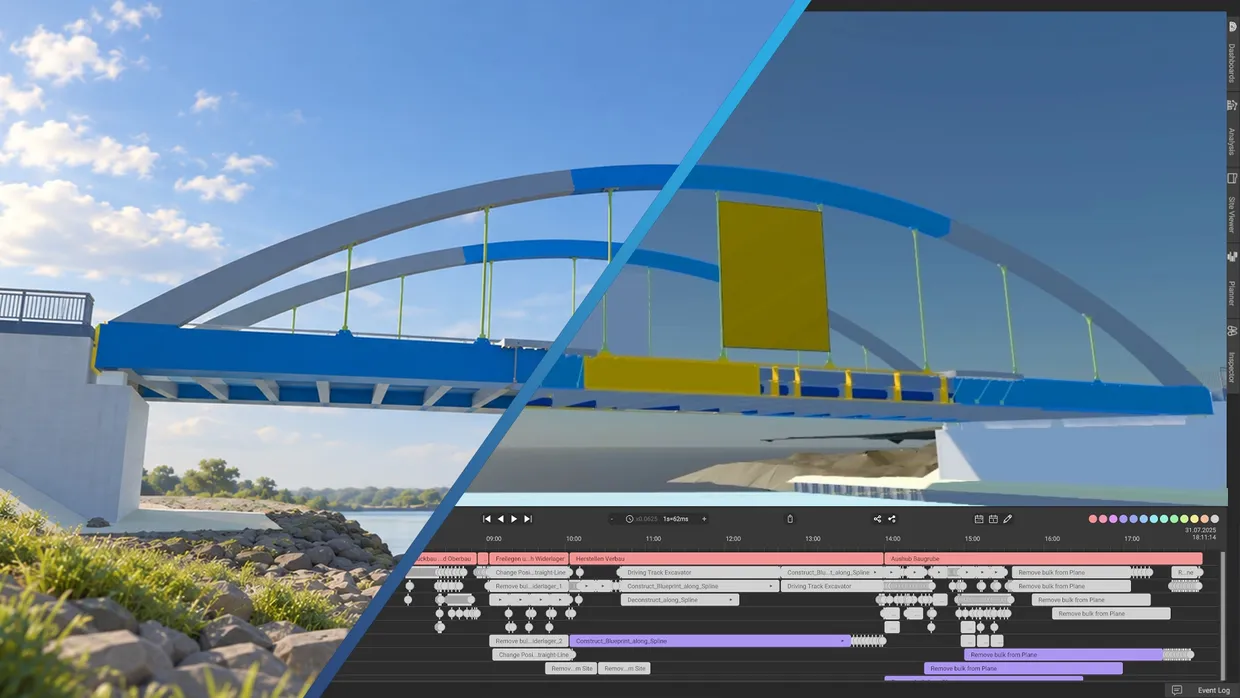
Simulation vs visualization: the difference is not whether something moves on screen, but how the process you see is created. A visualization makes a predefined process visible. A simulation calculates it from rules, productivity data and dependencies, and shows what follows. This article explains how to tell the two apart and when you need which.
Visualization: showing the planned process
A visualization makes existing information visible and easy to grasp. In construction, this usually means linking an existing schedule to a 3D model. This approach is known as 4D BIM.
You can then see which component is built when, and what state the structure is in at any given point. That is very useful for aligning with boards, neighbors or the project team.
Even when the structure grows in the model, cranes turn and construction stages change, a visualization is still a display of predefined information at its core. It shows what the schedule says. It does not test whether that is actually buildable. The same applies to any animation of the construction process.
Put simply: visualization means “show me the planned process.”
Simulation: calculating and testing the process
A simulation goes one step further. The process is not just displayed. It emerges from the rules, calculations and dependencies stored in the model. These include, for example:
- productivity rates and labor values
- quantities and the durations that result from them
- equipment and resources
- spatial and time dependencies
- interim states of the structure
- logistics and process chains
The result is a far more detailed model of the planned reality. You do not just see when something is supposed to happen according to the schedule. You can trace why a process turns out the way it does, and what changes when an assumption is wrong.
Put simply: simulation means “calculate the process from defined assumptions and show me what comes out.”
An example: the column on day 10
The difference becomes clear with a single component.
Visualization: The schedule says “Day 10: install column.” The model shows the column on day 10. Whether it can actually stand on that day remains open.
Simulation: Before the column can be built, the haul road and foundation must be finished. That requires specific equipment, crews and output. From these conditions, the simulation calculates the earliest day the column can be built. If that day falls after day 10, the conflict shows up in the model, not on site.
A visualization communicates a process. A simulation models and tests a process.Marlon Gilfert, COO & Head of Process Engineering
Simulation vs visualization: why it matters for owners
A visualization can be an important output of a simulation. The real work, however, lies in the calculation and process model behind it. For you as an owner, this has three practical consequences:
- You know what you are having checked. An animated schedule shows what is planned. A simulation shows whether it works. Only the second helps you assess buildability before contract award.
- You can compare options. Because the process is calculated, you can change assumptions: an extra crane, a different construction phase, a different delivery plan. The simulation shows how duration and bottlenecks shift.
- You specify the right service. If you need a simulation but only put 4D BIM out to tender, you get nice pictures and no answers. So ask what drives the process in the model.
That is why our software dProB does more than link schedule and 3D model. We model the construction process through activities, output and dependencies, and then analyze it.
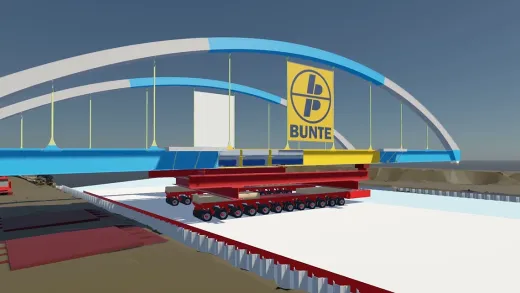
The Loeringhoff bridge shows how big the difference can be. A steel bridge weighing around 500 tonnes had to be moved to the river and turned in a very confined space. A visualization would have shown the bridge at the riverbank on the planned date. The simulation, built on a 1:1 model of the terrain, showed something else: the access was too narrow for the running gear to travel as one unit. The heavy-load transporters had to approach one at a time and were only assembled at the riverbank. The process was settled before construction began.
Five questions that reveal the difference
In proposals and presentations, both services often look the same. These questions show what you are actually getting:
- Where do the activity durations come from? Are they fixed in the schedule, or calculated from quantities and productivity data?
- What happens when an assumption changes? Does someone have to adjust the schedule by hand, or does the model recalculate the process?
- Are equipment, crews and areas included? Or are only the components linked to dates?
- Does the model detect conflicts on its own? For example, when two activities need the same crane or an access road is still blocked.
- Can options be calculated against each other? And does the result show which option is faster, safer or cheaper?
If the answers are “from the schedule,” “by hand” and “no,” you are looking at a visualization. That is not wrong, but it answers a different question.
Conclusion: simulation tests what visualization shows
Moving pictures alone say nothing about the quality of a plan. A visualization makes a process easy to understand; a simulation tests it. If you want to know whether your construction process will work under real conditions, you need a model that calculates. To learn how a construction process simulation works in general, read our introductory article.
Frequently asked questions
What is the difference between visualization and simulation in construction?
A visualization shows a predefined process, for example a schedule displayed in a 3D model. A simulation calculates the process from quantities, productivity data, resources and dependencies. This lets it test whether the planned process works under real conditions.
Is 4D BIM a simulation?
4D BIM links a 3D model to the schedule and shows when each component is built. The process comes from the schedule and is not calculated. That makes 4D BIM a visualization, even though it is often called 4D simulation.
When do I need a construction process simulation instead of a visualization?
A construction process simulation pays off when you need to know whether a process is feasible: with tight deadlines, confined sites, complex logistics or several options to compare. A visualization is enough when an already tested process just needs to be presented clearly.
Can a simulation be visualized too?
Yes. Simulation results are usually shown as a 3D sequence so that everyone involved can follow them. The difference lies in the model behind it: in a simulation, the process you see is calculated, not predefined.

Free download · PDF · 2 pages
Do you need a simulation?
A decision tree with a few yes/no questions about your project. At the end, you know which service you need and what to provide for it.
Thank you! Your download is ready. We have also sent you the file by email.
Open the PDF