Cost · Construction process simulation
Construction process simulation cost: when it pays off
What a construction process simulation costs depends less on the size of your project than on the question it has to answer. What drives the effort, and when it pays off.
 Michaela Schlichting
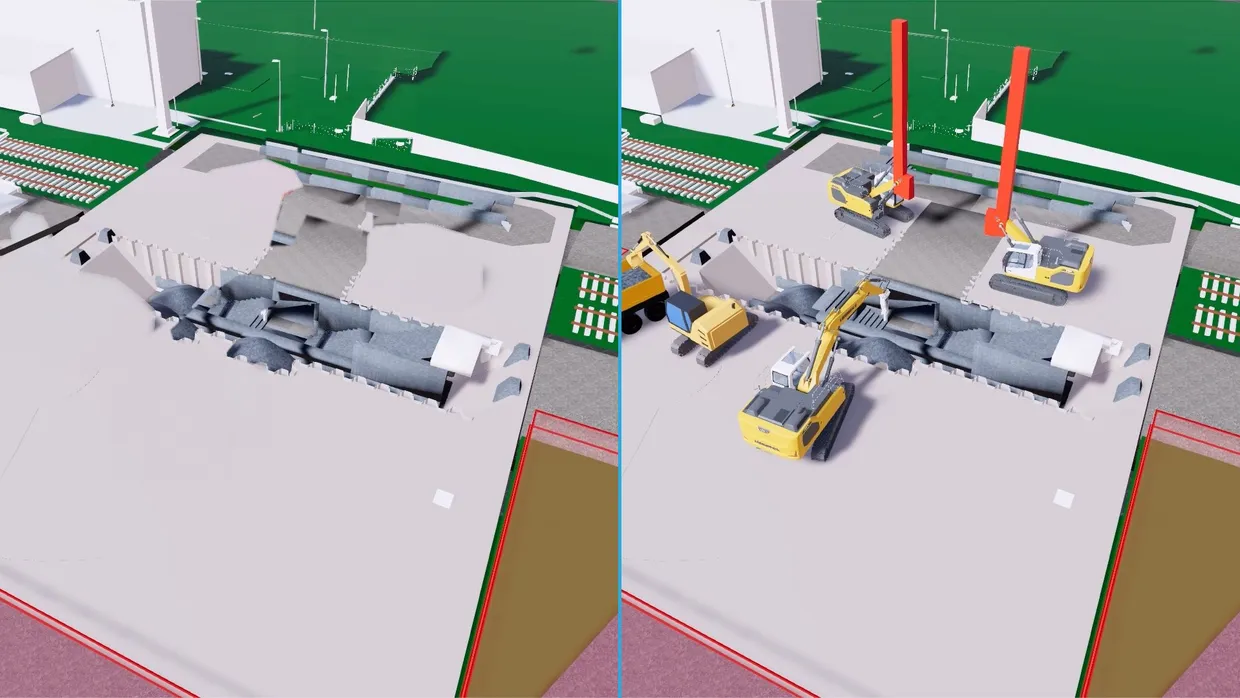
Construction process simulation cost depends on which questions the simulation has to answer and how precisely. A rough check of a few critical construction phases takes far less effort than a detailed simulation with equipment, logistics, and every dependency. That's why there is no off-the-shelf fixed price. Here's what drives the effort and when a construction process simulation pays off.
Construction process simulation cost: the question drives the effort
A short but highly complex section can take far more effort to simulate than a long stretch of track with repetitive work. These five factors matter most, in order of weight:
- Level of detail: Do you want to check an overall construction process for plausibility, or simulate individual work steps with resources, equipment, logistics, and dependencies?
- Quality of input data: Are schedules, building models, and construction phases available in structured form, or do they need to be prepared first?
- Complexity of the construction process: construction phases, parallel activities, spatial dependencies, interfaces between trades, and above all logistics constraints.
- Number of options: Every option adds effort. But because the groundwork can be reused, effort doesn't grow in a straight line.
- Project size: It plays a role, but rarely decides on its own.
A simulation gets leaner when you start early, define the question clearly, and focus on critical construction phases and interfaces. Existing models and well-structured schedules also reduce the effort.
Rough check or detailed simulation: getting started and billing
You don't have to start with a full simulation. It makes sense to first agree on the critical questions:
- Where is the construction process uncertain?
- Which interfaces and dependencies are especially critical?
- Which decisions should the simulation support?
- Which insights do you actually need?
Then you can decide whether a high-level plausibility check is enough or a detailed simulation is needed. A first assessment of specific questions takes significantly less effort.
Two routes, two pricing models: There are basically two ways to use construction process simulation.
- Use the software yourself: Your team learns the simulation software and runs simulations on its own. This pays off if you simulate construction processes regularly and want to build up the people and know-how to do so. It is billed as a license, priced by license model, number of users, and scope.
- Commission Process Engineering: Our specialists build the simulation for your specific question, evaluate it, and review the results with you, so you don't need to tie up your own resources. The service is priced per project, based on the expected effort and the agreed scope. A reliable estimate of scope and cost is possible after an initial conversation and a first review of your documents.
The two can also be combined.
What you provide: schedules and construction process plans, design documents and 3D models, construction phases, logistics constraints, track possessions, and subject-matter contacts. If the documents are well prepared, your effort is usually limited to providing them, joining coordination meetings, and reviewing results. The decisions stay with you.
What it costs not to simulate
Cost risks in construction are real. A 2015 study by the Hertie School of Governance found that completed large public projects in Germany ran 73 percent over budget on average, transport projects 33 percent, and public buildings 44 percent (study “Large-scale projects in Germany”, in German). In the construction process itself, cost overruns typically arise in five places, in our experience:
- Undetected conflicts: Activities are scheduled at the same time but rule each other out because of space or limited resources.
- Inadequate logistics: missing storage areas, unsuitable access roads, crossing haul routes, equipment movements that weren't planned for.
- Unrealistic schedules: Work doesn't fit into the planned time windows.
- Late redesigns: Problems only surface during construction and force short-notice changes.
- Delays and overrun track possessions: On infrastructure projects, these affect operations and the trades that follow.
A typical example: In the schedule, two activities run in parallel without a problem. Only when you look at them in space do you see that both need the same work area, the same track section, or the same access road. If this only comes to light on site, the result is downtime, redesign, or postponed follow-on work. Our article on clash detection shows which conflicts typically come up.
For owners, delays, the resulting extra costs, and the lack of cost certainty weigh heaviest. On rail projects, a track possession can often be extended or rebooked only to a very limited extent. What an hour of overrun costs, however, can't be stated across the board: it depends on the line, its operational importance, the contracts, and replacement services.
The biggest lever is in the feasibility study
A simulation rarely delivers its greatest economic value by shaving a few days off a schedule. The value comes mainly from spotting risks and wrong assumptions while they are still easy to correct. A design change in an early project phase usually costs far less than a short-notice redesign during construction.
A simplified example: An owner has to decide whether to repair an existing structure while it stays in operation or to demolish and replace it. Repair is considered hardly feasible because it's unclear whether the work will fit into the available time windows, areas, and construction phases. A rough simulation in the feasibility phase shows whether it works and in what sequence. If repair is feasible and the cheaper option, the project avoids demolition and new construction. If it isn't, the decision to replace rests on a verified basis instead of an assumption.
How much can depend on such a decision is shown by a railway bridge in Linz, Austria1. According to a 2012 report by TU Wien, repair alone would have cost around €40 million. Because it seemed possible only on land (dismantling the spans, shipping them to the riverbank, raising the bridge by one meter) and an additional bridge for road traffic was needed, it came to €90–98 million including maintenance. A new bridge built next to the old one while traffic kept flowing: around €57 million.
A large part of the difference came down to assumptions about the construction process, and a simulation checks exactly those early, for example whether repair could have been done section by section while the bridge stayed in operation. Whether that would have worked in Linz can't be judged from the outside.
Assessing benefits honestly: three kinds of statements
When you read proposals or project reports on the benefits of a simulation, it's worth checking which kind of statement is being made:
- Proven results of the simulation: “The simulation identified X potential conflicts.”
- Calculated improvements: “An alternative construction process reduced the planned duration on paper.”
- Savings actually realized: “Construction was completed X days faster than originally planned.”
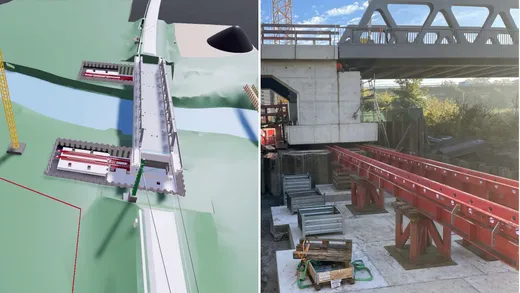
Only the third kind describes time or money actually saved on site, and it needs solid evidence from construction. An example of the first kind, with the result confirmed during construction, is the Else railway bridge replacement: The simulation showed that demolition, slide-in, and restoration would fit into the 55-hour track possession. During construction, the track possession was met.
Beyond money, what many owners value most is decision certainty: a shared picture of the construction process, conflicts found during planning rather than on site, options that can be compared, and decisions that can be justified to boards and committees.
Be cautious with guaranteed savings or flat savings rates. A simulation can pay for itself by avoiding a single critical conflict, but that doesn't add up to a universal rate.
Bottom line: ask the better question
What a construction process simulation costs can only be answered once it's clear what it needs to answer. So start by asking which risks you need to know about before construction and which decisions depend on them. That shows whether a rough check of critical phases is enough or a detailed simulation makes sense, and the earlier you ask, the cheaper the answer. See how we support owners on our page for owners & builders.
The question shouldn't only be “What does a simulation cost me?” but rather “Which risks do I want to identify before construction, and which decisions can I make on a sounder basis as a result?”Marlon Gilfert, COO & Head of Process Engineering
1 Source: TU Wien, “Eine neue Donaubrücke für Linz” (in German), May 10, 2012 (expert report by Prof. Josef Fink commissioned by the City of Linz). BII was not involved in this project. ↩
Frequently asked questions
How much does a construction process simulation cost?
There is no fixed price. If you run simulations yourself, you use a software license. If you commission the simulation, the cost depends on the level of detail, the available data, the complexity of the construction process, and the number of options. A rough check of a few critical construction phases costs significantly less than a detailed simulation. A reliable estimate is possible after an initial conversation and a review of your documents.
When does a construction process simulation not pay off?
When the construction process is simple and easy to oversee, there are few dependencies, and there are no critical time or space constraints. Also when the question can be answered with simpler methods, or when the simulation can no longer influence any relevant decisions. A full simulation may then be uneconomical, while a targeted look at individual critical phases can still make sense.
Does a simulation guarantee cost savings?
No. A simulation reveals risks and opportunities for improvement. Whether and how much money is actually saved depends on many other factors, such as decisions by the project team and unforeseen events during construction.