Constructability · Approach
Constructability review: how it works in 6 steps
Whether a construction process will work can be tested before work starts. When a constructability review makes sense, how it runs in 6 steps, and what you get at the end.
 Michaela Schlichting
A constructability review tests, before work starts, whether a planned construction process can be carried out under the real conditions of a project. The question is not whether the structure will stand, but whether the way there is workable: whether space, access, equipment, and time windows fit the process. This article explains when a constructability review pays off, how it runs in six steps, and what you have in hand at the end.
What a constructability review checks and what it does not
A constructability review examines the planned construction process to see whether it actually works under the given constraints. The aim is to find conflicts, bottlenecks, and unrealistic assumptions early and, where needed, to study alternative sequences. The usual tool for this is construction process simulation.
It is just as important to be clear about what the review is not:
- not a structural calculation or structural verification
- not a technical design check
- not a substitute for the design disciplines and their responsibility
So a constructability review does not replace construction planning. It makes the planning assumptions testable, while design responsibility stays with the project team. Why this matters is shown by the 8 challenges in construction: many of them arise because constructability is considered too late.
When the review pays off: once a first process exists
A constructability review needs a construction process that can be examined. That can already be the case during design. The focus shifts with the project stage. In Germany, these stages are the work stages (Leistungsphasen) of the HOAI fee scale:
| Work stage | Focus of the review |
|---|---|
| Stage 2, preliminary design | rough feasibility and basic process alternatives |
| Stage 3, design | critical construction states and basic logistics concepts |
| Stages 4–5 | refining and checking the planned construction process |
| Stages 6–7 | durations, constraints, and execution alternatives before award |
| Stage 8 | specific sequences, optimization, and adjustment to changes |
The mapping is a practical guide, not a rigid HOAI classification. It is too early if no key constraints and no process to examine exist yet. It is too late once the construction process is fixed by contract and organization, and every change takes considerable effort. Marlon Gilfert, Head of Process Engineering at BII, puts it this way: “The earlier critical conflicts are identified, the more room you have to act.”
Prof. Dr.-Ing. Christof Gipperich and Prof. Dr. Sebastian von Mammen go a step further in their peer-reviewed paper in the journal Bauingenieur (issue 09/2026, in German). They propose checking constructability in every work stage at the level of detail reached so far. Constructability then stops being a downstream check and becomes an early design variable.
A review is usually triggered by specific questions:
- Can the planned construction time be met?
- Are the planned track possessions long enough?
- Can several trades really work in parallel?
- Are the laydown areas sufficient, and does site logistics work?
- Which process alternative makes more sense under the given constraints?
- Can critical construction states be carried out while operations continue?
Constructability review in 6 steps
- Define the goal. Which questions need answers, which construction states are critical, and how far does the review go? Involved: owner, designers, simulation team.
- Review the data. Schedules, models, quantities, productivity assumptions, and logistics constraints are reviewed and prepared. Involved: designers, construction company if applicable, simulation team.
- Build the process model. The planned construction process is turned into a simulation-ready process model. Involved: simulation team.
- Simulate and analyze. The model reveals conflicts, bottlenecks, capacity limits, and time dependencies. Involved: simulation team, in coordination with the designers.
- Study alternatives. Possible adjustments and alternative sequences are run and compared. Involved: simulation team, designers, construction company if applicable.
- Evaluate the results. The project team assesses the findings together and derives recommendations. Involved: owner, designers, simulation team, construction company if applicable.
Whoever carries out the review does not take on the role of construction planner. The first step is to check whether a conflict is truly relevant or can be explained by a constraint that was not yet considered. Those responsible then plan the adjustments. Ideally, the adjusted process is simulated again. That shows whether a conflict has really been resolved or whether new dependencies have emerged.
Which documents you need, and what if some are missing
- Process and schedule: a schedule, a phasing plan, or at least a clear description of the construction sequence
- Geometry: ideally 3D models, for example as IFC files; alternatively 2D drawings, site plans, sections, or as-built documents
- Quantities and productivity: quantity estimates, construction methods, equipment, and productivity data
- Logistics: laydown areas, access roads, haul routes, and storage areas
- Time constraints: track possessions, working-hour windows, operational restrictions, and milestones
Not everything has to be complete. Missing information is filled with reasoned assumptions and documented, clearly separated from confirmed input data. The earlier the project stage, the coarser the review. A first comparison of alternatives is possible even without a finished 3D model.
What you have in hand at the end
What exactly you receive depends on the agreed scope. Typical results are:
- an analysis report with the processes studied, assumptions, and conflicts found
- a conflict overview of critical spatial, time, and logistics dependencies
- a comparison of alternatives and their effects
- schedule insights on activity durations, bottlenecks, and required time windows
- the simulation model with visualization, for example as a video or in a viewer
- recommendations and pointers to further checks
The review does not provide blanket proof that a project can be built in every respect. It evaluates whether the planned construction process is feasible, based on simulation. Or, as Marlon Gilfert says: “The real value lies in the insight, not in the visualization.”
Example: every fix is tested again
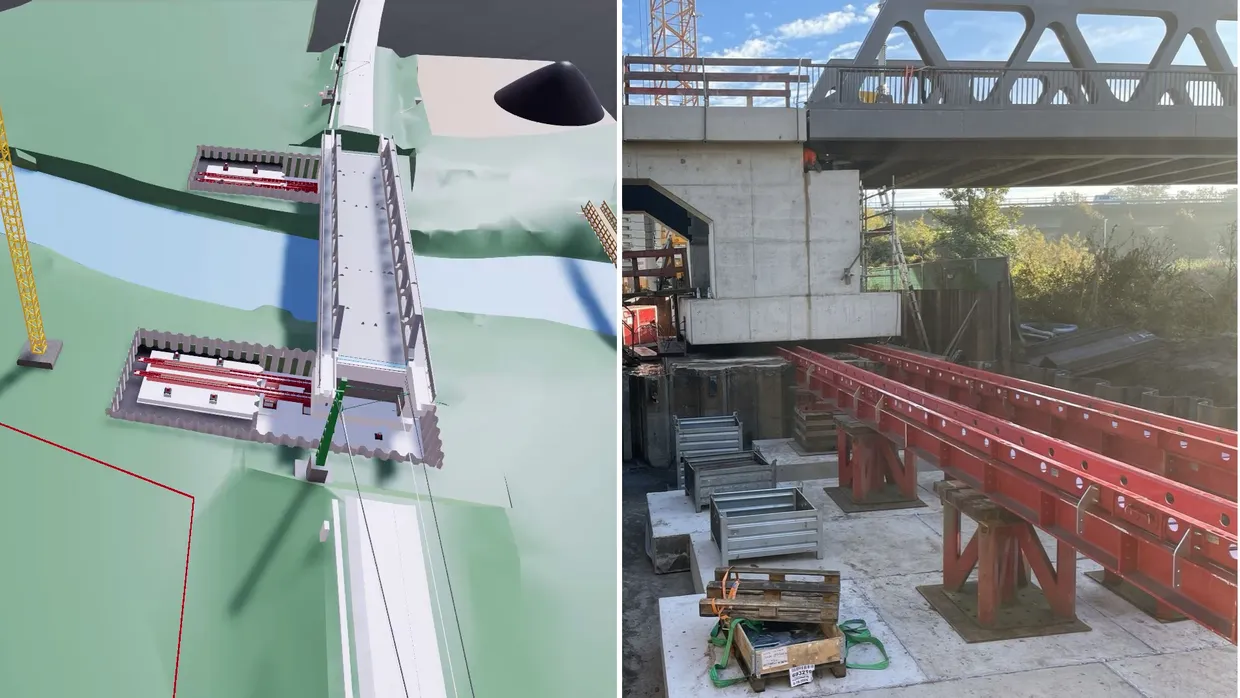
How steps 4 to 6 work together in practice is shown by the replacement of the railway bridge over the Else river in Herford, Germany, for DB InfraGO. Demolition, sliding the new bridge into place, and restoring the track all had to fit into a 55-hour track possession. In work stage 5, the planned construction process was simulated with the productivity data of the intended machines, the site surroundings, and the site layout plans.
The simulation revealed a chain of conflicts:
- The planned excavator could not reach its work area because existing infrastructure was in the way. Fix: a new excavator position and a re-planned excavation.
- The new position made haul routes for the excavated material longer, and the track possession would have been exceeded. Fix: more truck capacity.
- The additional trucks backed up at a narrow point. Fix: improved site roads and additional passing places.
Every fix was simulated again and checked for its effect on schedule and logistics. In total, the simulation uncovered more than three critical conflicts before work began. During execution, the track possession held. Details are in the Else railway bridge case study.
Five reasons constructability reviews fall short
- Only the schedule is checked. Spatial and logistics conflicts then go unnoticed (see 6 blind spots in the construction schedule).
- Only the 3D model is checked. A geometric clash detection does not show whether the process works in terms of time and organization.
- The input data is insufficient. Missing information or unrealistic assumptions make the results unreliable.
- The review comes too late. Conflicts only surface once the key decisions have been made.
- The results are not fed back. Value is only created when findings are assessed and implemented in the planning.
A simulation alone does not improve a construction process.Marlon Gilfert, COO & Head of Process Engineering
What the review cannot do
A simulation-based constructability review only covers the processes and constraints included in the model. It does not replace structural verification or missing design work. It cannot guarantee error-free input data, construction time, or cost, and it cannot fully anticipate unforeseeable disruptions. What it does: systematically find recognizable problems before execution.
Bottom line: clarify the question, then review
A constructability review is most useful when it starts early and answers a clear question. Before you commission one, settle three points:
- Which specific risks or questions should be checked?
- Which input data is available, and which assumptions need to be made?
- Which decisions should the results inform?
The review can be commissioned as a standalone consulting service, as part of a design or project management contract, or through the construction company carrying out the work. How we approach it is described on our Process Engineering page.
Frequently asked questions
What is a constructability review?
A constructability review checks whether a planned construction process can be carried out under the spatial, time, logistics, and capacity constraints of a project. It uncovers conflicts, bottlenecks, and unrealistic assumptions before construction starts. It does not replace structural design or a technical design check.
When should constructability be reviewed?
As soon as a first reliable construction process exists, often already during design. In German projects, the review is most useful in HOAI work stages 3 to 5 and when preparing the tender. The earlier conflicts are found, the more room there is to act.
Which documents does a constructability review need?
A schedule or phasing plan, geometry as a 3D model or 2D drawings, quantities and productivity assumptions, and logistics and time constraints such as laydown areas and track possessions. Missing information can be replaced with documented assumptions.
Does a constructability review replace structural design or a design check?
No. It tests the construction process, not the technical or structural feasibility of the structure. Structural verification, design checks, and the responsibility of the design engineers remain unaffected.
How do you commission a constructability review?
As a standalone consulting or review service, as part of a design or project management contract, or through the construction company. Under the German HOAI fee scale, it can be agreed as a separate service, depending on the contract. What matters is defining the scope and the expected results clearly up front.