Fundamentals · Scheduling
Why a construction schedule is not enough: 6 blind spots
A construction schedule shows when work happens, not whether it can. Six blind spots where plausible timelines fail on site, and when to have your schedule checked.
 Michaela Schlichting
A construction schedule is not enough on its own once space, logistics and trades are tightly linked: it shows when work should happen, but not whether the process can actually be carried out under real site conditions. Two activities can be scheduled in parallel and still be impossible to run at the same time because they need the same space. This article covers the six typical blind spots of a schedule, when it is still sufficient, and when you should have it checked.
What a construction schedule does and does not do
A construction schedule sequences the activities of a project, links them logically and sets milestones. No project can be managed without one. Owners work with high-level master schedules early in design, and these become more detailed up to construction.
But the schedule leaves one question open: whether the work is feasible at the planned time in terms of space, logistics and the planned capacity. Coordinated in time and logic is not the same as buildable. This is no argument against scheduling. Complex projects simply need an additional layer of review.
Six blind spots in the construction schedule
These six factors decide whether a date holds, yet none of them shows up in a bar. In the experience of our process engineering team, the first three have the biggest impact.
1. Space over time
The schedule does not tell you whether the required space is free at the planned time. Typical cases:
- Two trades need the same work area at the same time.
- A laydown area is already needed for another construction stage.
- Material storage, equipment and access routes block each other.
2. Logistics and access routes
How material, crews and equipment reach the work face is rarely captured in enough detail. Access roads, bottlenecks, material handling and conflicting transport movements hide inside the durations of other activities.
3. Estimated rather than calculated durations
Durations are often based on experience. Whether the planned output is achievable under the specific site conditions is not always checked. Durations that are too tight are a frequent cause of delay.
4. Equipment and crews
Equipment does not just have to be available. It has to reach the work area, needs room to maneuver there, and must not be planned for somewhere else at the same time.
5. Spatial dependencies between trades
Schedules contain logical links, but spatial dependencies are often missing. Activities then run in parallel on paper even though their space requirements make that impossible.
6. Disruptions and alternatives
A schedule shows one preferred target sequence. What happens if equipment underperforms or a work area becomes available later remains open.
The spatial and logistical factors are especially critical: they are not directly visible in the schedule, so some only surface during construction.
A schedule shows when something is supposed to be built. It does not prove that the planned process will actually work.Marlon Gilfert, COO & Head of Process Engineering
Example: the timing works, the space does not
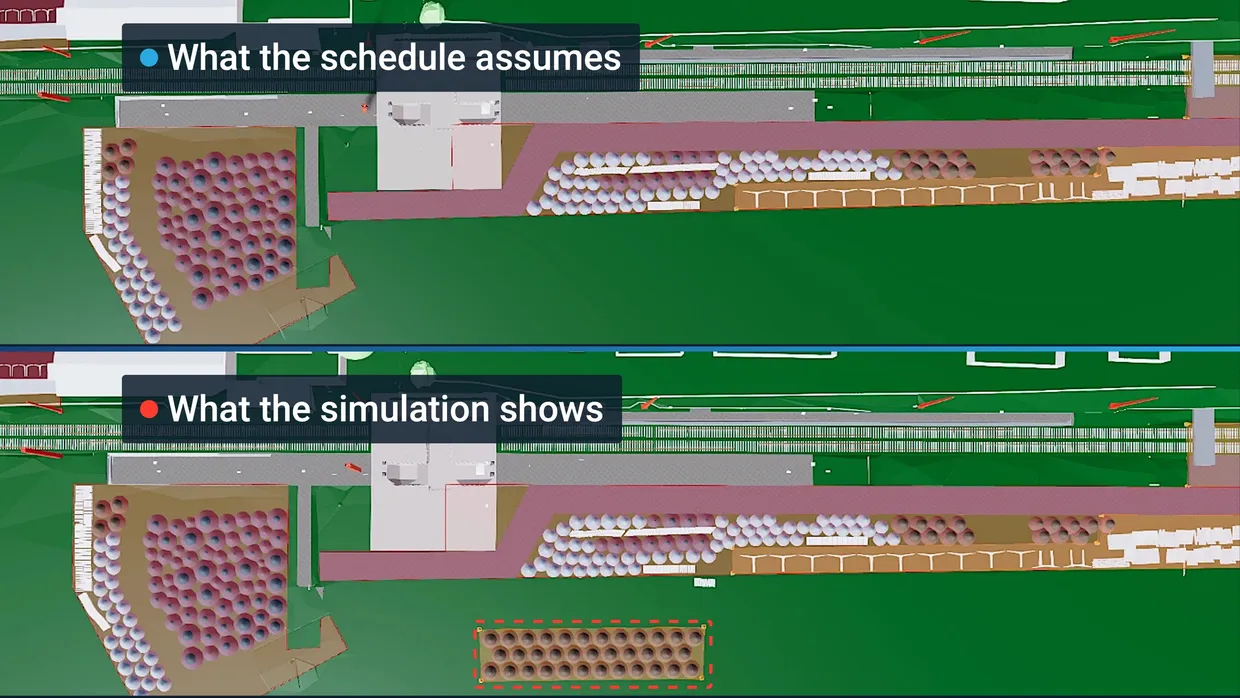
When the Neupetershain station was rebuilt for DB InfraGO, the pace of a twelve-week track possession depended on this project. The real bottleneck, however, was space: seven disciplines placed demands on the same tight site at the same time. Protection zones around existing trees and on-site refurbishment of the historic platform canopies took up even more room.
The simulation therefore tracked, phase by phase, how much space the site needed at any given time. It showed, for example, that an open, sloped excavation would have needed space for the extra digging that simply did not exist. The decision for a shored excavation was made before construction began. In the schedule, every activity had its time slot. The conflicts over space only became visible in the simulation, so they could be resolved before the possession started.
When the schedule is enough and when to check it
A schedule alone can be perfectly sufficient if the project is manageable, few trades work at the same time, space and resources are ample, the processes are well proven and there are no critical time windows.
The more complex the spatial, logistical and time dependencies, the more a construction process simulation adds. It does not replace the schedule but tests it: durations follow from quantities, equipment output, transport capacity and mutual interference, and alternatives can be compared under the same assumptions. A 3D model that merely plays back the schedule cannot do this (see Simulation vs visualization).
A simulation is only as reliable as the productivity assumptions behind it.Marlon Gilfert, COO & Head of Process Engineering
Bottom line: check the schedule before it becomes a contract
You have the most room to act before contract award. Problems found then can be addressed with comparatively little effort. Ask two questions about every schedule:
- Was it only coordinated in time and logic, or was it also checked whether the work can be carried out under the actual spatial, logistical and capacity constraints?
- Which critical construction stages were reviewed, and what assumptions are the activity durations based on?
Learn how we support owners on our page for owners and builders.
Frequently asked questions
What is a construction schedule?
A construction schedule, often shown as a Gantt chart, sequences the activities of a project, links them logically and sets milestones. It shows when work is supposed to happen. It does not show whether that work is feasible in terms of space and logistics.
How do I check whether a construction schedule is realistic?
Ask what the activity durations are based on and whether space, access routes and equipment were checked for every point in time. For complex projects, the process can be calculated with a construction process simulation that also compares alternatives.
Does construction process simulation replace the schedule?
No. It adds a layer of review and shows whether the planned process works in terms of space, logistics and planned capacity. Design responsibility stays with the project parties in charge.

Free download · PDF · 1 page
Blind spots in your schedule
All six blind spots on one page, each with a checking question, plus the two questions to ask your designers and contractors about any schedule.
Thank you! Your download is ready. We have also sent you the file by email.
Open the PDF