Rail · Track possessions
Track possession planning: 5 mistakes to catch early
Logistics, dependencies, productivity rates: five mistakes keep putting track possessions at risk. How to spot them early and test the construction process in advance.
 Michaela Schlichting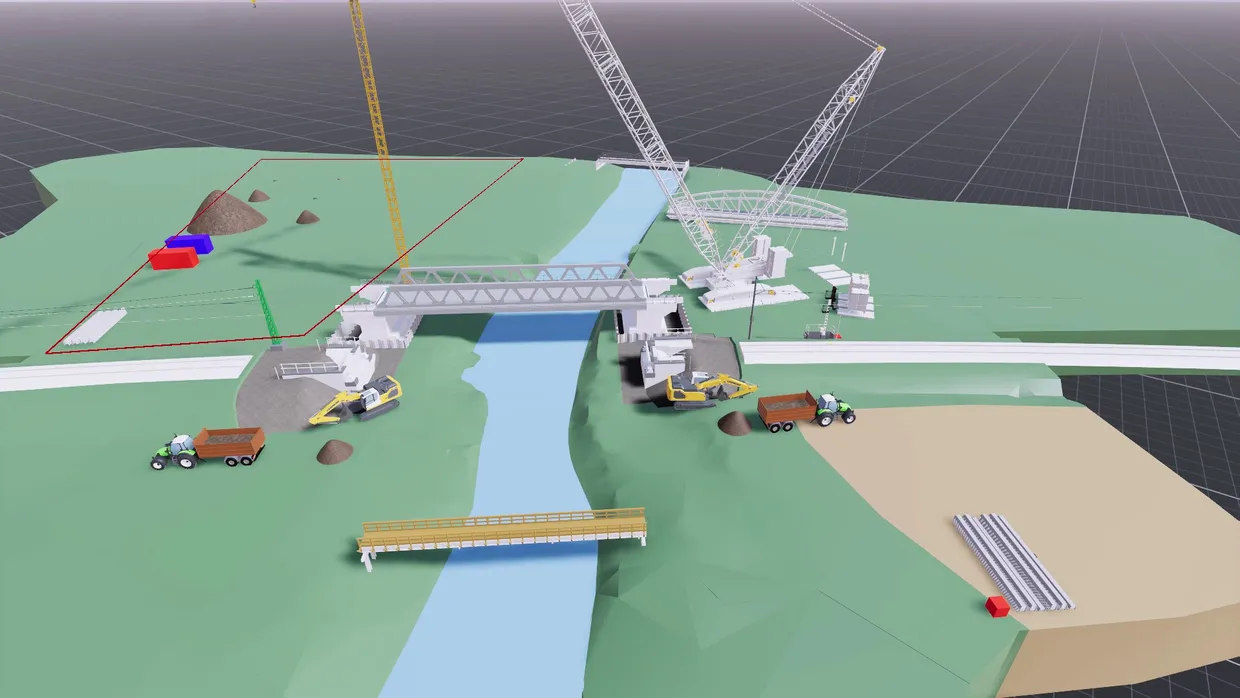
Track possession planning rarely fails because of unknown risks. It fails because of five recurring mistakes: underestimated logistics, missing dependencies, optimistic productivity rates, an incomplete chain of activities and no plan for disruptions. Each individual sequence can look plausible, and the overall process still does not work. This article shows how to spot the five mistakes early and how to test the construction process before the line is closed.
Why a possession is more than a construction deadline
A track possession has one feature that explains many planning problems: the operational requirement is registered very early, often several years before the work. At that point, the construction process is rarely planned in detail. For station projects, DB InfraGO therefore recommends standard possession times at this early stage, because the planning depth needed for a precise calculation is still missing (DB InfraGO: construction operations at passenger stations, in German).
Methods and detailed sequences can still be optimized later. The operational framework hardly can, because timetables, train operators, diversions and replacement services depend on it.
That is why an overrun is not an ordinary construction delay. At the end of the possession, the infrastructure must be back in a defined condition that trains can use. If it is handed back late, train services, following trains and connections are affected.
How hard a mistake hits depends on the length of the closure. In a night possession, a delay of 30 or 60 minutes at the start can push back the entire chain of activities. A closure lasting several weeks leaves more room to reorganize, but adds parallel trades and interfaces.
The shorter the possession, the more it depends on a robust plan for the chain of activities. The longer the closure, the more it depends on managing interfaces, logistics and parallel work.Marlon Gilfert, COO & Head of Process Engineering
Track possession planning: the 5 typical mistakes
Many parties plan a possession together: project management, design and construction operations planning, timetabling, construction companies, site supervision, safety, logistics, and trades such as track and overhead lines. Friction rarely arises within one discipline. It arises between them.
1. Logistics, haul routes and space are underestimated
- What happens: Machines, materials and crews get in each other's way. Access roads are blocked, and material is not where it is needed.
- Why it is missed: Schedules show time well, but space poorly.
- Early warning signs: many parallel activities in a tight space, few access points and large material movements.
Marlon Gilfert sees this as the most underestimated mistake. A conventional schedule answers very well when something should happen. It answers only partly where, with which equipment, via which haul route and alongside whom the work takes place. This is where site logistics and laydown area planning come in.
2. Dependencies between trades are missing
- What happens: Trade B could start according to the schedule but cannot actually work yet.
- Why it is missed: Schedules show formal dependencies, but not all spatial and technical ones.
- Early warning signs: many parallel trades and handover points.
3. Productivity rates are too optimistic
- What happens: The planned output per hour or shift is not reached, and the process falls further and further behind.
- Why it is missed: Ideal or experience-based values are adopted without enough regard for the actual site conditions.
- Early warning signs: productivity rates that only work under ideal conditions, because travel, setup and ancillary times are missing.
4. The chain of activities ends at “installation complete”
- What happens: The main construction work is done, but clearing the site, testing, removing temporary works or recommissioning are missing from the process.
- Why it is missed: The focus is on the productive main work.
- Early warning signs: a schedule that effectively ends with “installation complete.”
Removal, installation, testing, restoration and commissioning therefore belong in the same analysis.
5. Disruptions are not part of the plan
- What happens: Even a small deviation sets the critical sequence slipping.
- Why it is missed: The plan describes the target state, not how robust it is.
- Early warning signs: no reliable float, no alternatives, and a critical machine without a backup strategy.
The most expensive mistake is the one on the critical path that is found late and puts the timely return to operation at risk, whether it is a missing machine, a blocked haul route or an unrealistic productivity rate.
The float that does not exist in a possession
One common fallacy concerns float. Float calculated in the schedule is not automatically float you can use during the possession. If the next activity needs the same area, the same machine or the same access road, lost time cannot simply be recovered by working in parallel.
On top of that, the full possession time is not all productive construction time. Part of it is needed for operational, safety and logistics activities and for setting up and handing back. DB InfraGO's guideline on construction and possession times therefore distinguishes between gross and net possession time and explicitly considers the related activities (Leitfaden Bau- und Sperrzeitenkatalog, PDF in German). If you plan with the gross time, your float is gone before the first machine starts.
Testing a possession in advance: four steps
Whether a planned process fits the possession can be tested before the line is closed. Construction process simulation combines time, space and logistics in one model. With our simulation software dProB, we work in four steps:
- Bring the planning inputs together: possession times, construction phases, schedules, models or drawings, construction methods, machines, productivity rates and logistics.
- Model the construction process: The planned activities are linked in space and time, including machines, resources, transport movements and space requirements.
- Simulate and find conflicts: We test whether the process actually works under the given constraints, in time, space and logistics.
- Compare variants and secure the plan: Critical points are adjusted, variants are analyzed, and the optimized process is documented so others can follow it.
What matters is this: the simulation does not just turn an existing schedule into moving pictures. It tests whether the planned construction process can actually be built. Read more about the difference in Simulation vs visualization.
Example: 55 hours at the Else railway bridge
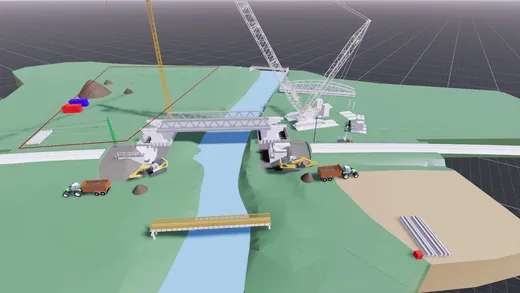
The renewal of the Else railway bridge in Herford for DB InfraGO shows how this works in practice. Removing the old bridge, lifting in and sliding the new one, and restoring the track all had to fit into a 55-hour possession. Using real productivity data for the machines, the simulation uncovered this chain of conflicts, among others:
- The planned excavator clashed with existing infrastructure and could not reach its work area. It was repositioned and the excavation replanned.
- The new position made the haul routes for excavated soil longer. The possession would have been overrun. Additional trucks made up for it.
- The extra vehicles backed up at a bottleneck. Improved site roads and passing places solved the problem.
Each fix created a new conflict, and all three were about space and logistics. During construction, the possession held. In longer closures, interfaces move to the fore: at Neupetershain station, seven disciplines placed demands on the same tight space at the same time during a twelve-week possession. The simulation showed when and where they would clash and proved that the process fits into the twelve weeks.
A simulation cannot predict the site exactly, and it does not replace design or construction planning. It makes critical points visible early and gives decisions a much better basis.
Conclusion: test early, while variants are still open
The five mistakes are well known, and they can be spotted early. Today, simulation is often commissioned only once the schedule and possession concept are fixed. At that point it can test the plan. Brought in earlier, at the latest when construction phases, methods and possession times take shape, it can compare variants and actively optimize the process. DB InfraGO also sees the greatest benefit of construction operations reviews in the early design stages (work stages 1 to 4 under the German HOAI fee scale). Learn how we support owners in this.
Frequently asked questions
Do short and long possessions suffer from the same mistakes?
Yes. Wrong productivity assumptions, missing dependencies, poor logistics, lack of space and badly planned interim states occur in night possessions as well as in closures lasting several weeks. The difference is the impact: in a short possession, lost time can hardly be recovered. In a long closure, the number of parallel trades and interfaces grows instead.
What happens if a track possession overruns?
If the infrastructure is not handed back in time in a condition trains can use, scheduled services, following trains and connections are affected. In the worst case, further operational measures become necessary. On site, extra hours for crews, equipment and machines add cost.
What is the difference between gross and net possession time?
Gross possession time is the full period during which a track is closed. Part of it is needed for operational, safety and logistics activities and for setting up and handing back. Only the net possession time remains for the actual construction work, and that is the time the construction process should be planned with.
How long does a simulation for a track possession take?
It depends on project size, available data and scope. A rough activity structure, 2D drawings and assumptions about equipment, space and logistics are enough to start. A clearly defined section can be analyzed within a few weeks. Larger projects with several phases, variants and trades take longer and often run step by step alongside planning.

Free download · PDF · 2 pages
Possessions in 3 phases
From registration to execution: this three-phase checklist shows which questions you can settle when, so your construction process fits the possession.
Thank you! Your download is ready. We have also sent you the file by email.
Open the PDF