Fundamentals · 4D planning
4D planning: why simulation doesn't have to wait for BIM
A BIM model makes a construction process simulation more precise, but it isn't a prerequisite. Why the construction process can be tested early, and which data is enough.
 Michaela Schlichting
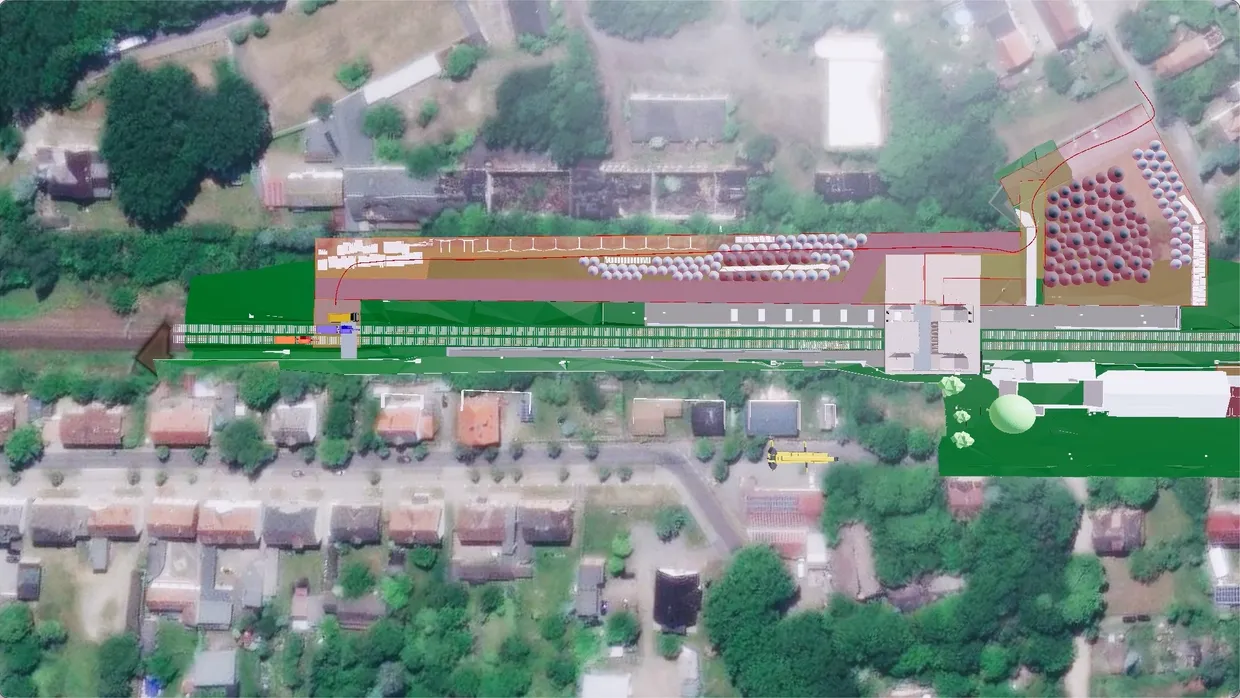
4D planning doesn't have to wait until the BIM model is ready. A model makes a construction process simulation more precise, but it isn't a prerequisite. Many decisions that shape the construction process are made long before a detailed model exists. This article explains why the process can be tested at that stage, which data is enough, and what BIM adds later.
The key decisions come before the model
BIM has changed planning: components, quantities and dependencies are structured, and everyone works on the same model. Link it to the construction schedule and you get 4D BIM. On many projects, though, a sufficiently detailed model only exists at an advanced design stage, sometimes not until detailed design for construction.
By then, much of the construction process is already decided, in particular:
- construction sections and phases
- the basic construction methods
- durations and milestones
- the booking of track possessions
- the basic site logistics and space concepts
- the dependencies between trades
These decisions shape the project's success. In practice, we are often brought in after they have been made, sometimes during tendering or even construction. At that point the process can usually only be optimized. Changing the construction concept itself takes considerable effort.
How early assumptions set off a chain of errors
Individual planning decisions look reasonable on their own. Their effect on the overall construction process often shows only later. A typical chain looks like this:
- Unsuitable construction sections
- Unrealistic durations
- Mismatched track possessions
- Spatial and logistics conflicts
- Delays and cost overruns
It gets especially critical when several trades need the same limited space or resources at once. We see this regularly on track works with tight possessions: the work seems to fit the time window. Only the spatial and temporal view shows that one trade can't start until another has cleared its area. Miss that, and everything that follows slips. The Else railway bridge shows how simulation secures a 55-hour track possession.
A classic schedule shows such dependencies only to a limited extent (six blind spots in the construction schedule). A construction process simulation makes them visible while options can still be explored.
Best started in the feasibility study
Simulation adds the most value while fundamental decisions are still open. That is the case in the feasibility study: construction methods, sections and logistics are still up for discussion, and a design change costs a fraction of replanning during construction. Our article on construction process simulation cost explains why that is where the biggest economic lever lies.
An early simulation isn't a one-off snapshot. It starts with simplified assumptions and gets more detailed as the design progresses. That way, insights feed back into the design instead of just illustrating a finished schedule at the end.
4D planning without a BIM model: what data is enough to start
The information a simulation needs depends on the question and the level of detail. At its core, there are five inputs:
- Geometry: existing structures, the planned structure and available space
- Process and dependencies: phases, work steps and their time and technical dependencies
- Quantities and productivity data: quantities to be built and assumed production rates
- Resources: equipment, crews and other limiting resources
- Constraints: track possessions, access, site logistics, operational restrictions
None of this has to be complete at the start. Existing infrastructure rarely comes with a digital model. In that case we work with 2D as-built drawings, PDFs, survey data, point clouds, aerial images and simplified geometric models. For deliveries by rail, for example, the track doesn't need to be modeled in 3D: the alignment is enough to calculate travel times and capacity.
Why we work with the data that's available instead of waiting for perfect documents is something Jonas Wolpold, Managing Director of BII, explained at InnoTrans 2026 (video in German). His conclusion: the more that's digital, the easier the start. But the data is never perfectly prepared.
What matters is the difference between an initial conceptual study and a robust detailed review. The more specific the question, the more precise the input data has to be. A 3D view becomes necessary once spatial relationships are decisive: tight sites, crane slewing areas, shared work areas, complex construction stages, excavations and logistics routes. Even then, a simplified 3D representation of the relevant objects and areas is often enough at first.
As much modeling as necessary, but no more than the question at hand requires.Marlon Gilfert, COO & Head of Process Engineering
When the model comes in
Once the BIM model is available, the simulation becomes more precise. Geometry and quantities can be imported directly, space and construction stages checked more accurately, and components matched to work steps more reliably. Processes, dependencies and resources don't have to be rebuilt; depending on the model structure, only the assignments need adjusting.
What a building model usually lacks, the simulation adds: interim stages, site setup areas, equipment, transport routes, laydown areas, construction methods and work directions. Only then does the model become a construction process that can be tested.
Set it early: write process testing into the tender
On larger infrastructure projects in particular, owners increasingly require model-based scheduling and 4D applications in their tender documents. Usually that means linking model and schedule and showing the process over time. Such a visualization shows when things get built, not whether they work that way. If you want a real test of the construction process, three building blocks help:
Three building blocks for the tender
- Define concrete objectives. Instead of only requiring the link between model and schedule, ask: Are the durations realistic? Are there spatial or time conflicts? Are the resources sufficient? Does the site logistics work?
- Simulate early and continuously. The simulation starts in early design stages and grows as the design progresses. If it starts only after the main decisions, often all that's left is visualization.
- Require traceable results. Documentation covers the conflicts and risks found, the options examined, the effects on duration and resources, and the measures derived.
Bottom line: test early, refine with the model
A construction process simulation shouldn't wait until the BIM model is complete. The key decisions come earlier, and the best time to test the process is the feasibility study. The model makes the simulation more precise later, but it isn't a prerequisite to start. Our goal is to test a schedule while it is being developed, not to illustrate it at the end. That's what we mean by computational construction process simulation rather than pure 4D animation, drawn from more than 150 client projects.
Frequently asked questions
Does a construction process simulation need a BIM model?
No. A first simulation can be built from simplified models and existing documents such as 2D drawings, alignments, point clouds or aerial images. A BIM model makes it more precise and saves modeling effort, but it isn't a prerequisite.
What is the difference between 4D planning and construction process simulation?
4D planning links the building model to the schedule and shows when each part is meant to be built. A construction process simulation also calculates resources, methods, space and logistics, and tests whether the planned process can actually be carried out.
When is the best time for a construction process simulation?
As early as possible, ideally in the feasibility study. At that point, construction methods, sections and logistics can still be changed. Later on, processes can usually only be optimized.
Does the simulation have to be rebuilt when the BIM model arrives?
No. The model is integrated into the existing simulation. Processes, dependencies and resources are kept; depending on the model structure, only the assignments are adjusted.