Cost · Change orders
Construction disruptions: why change orders start in planning
Construction disruptions and change orders often start in planning, with a process that was never going to work. Where disruptions begin, and how to spot them early.
 Michaela Schlichting
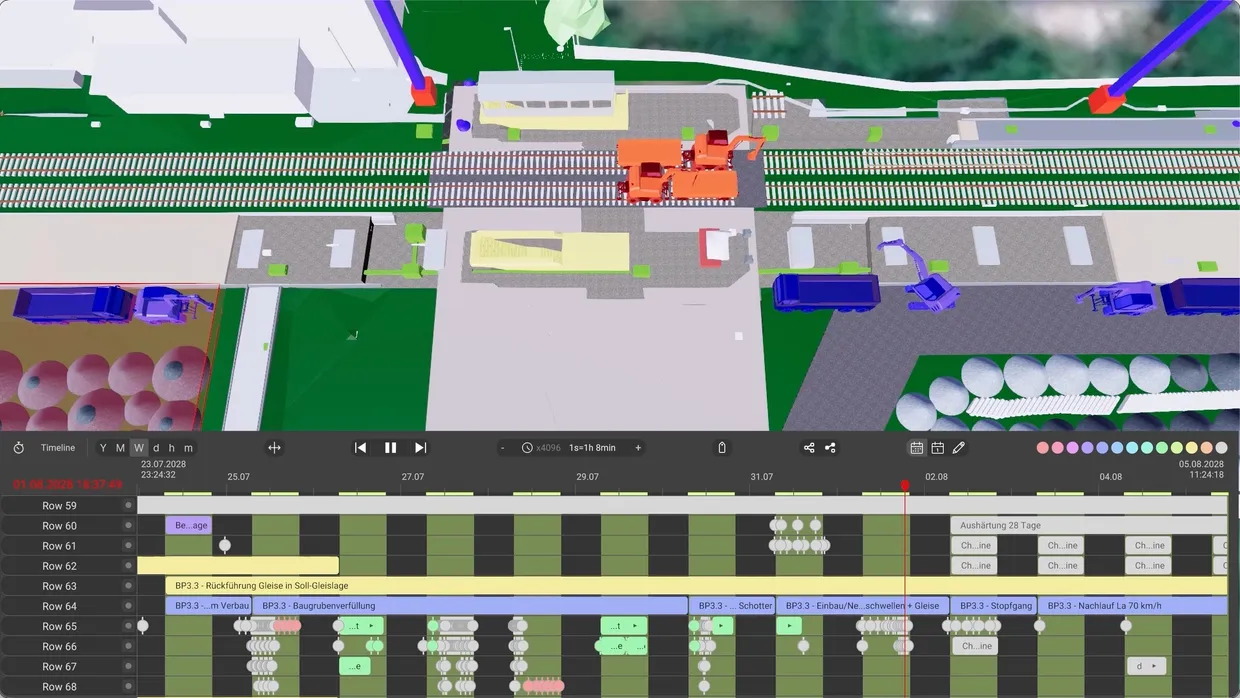
Construction disruptions often begin long before work starts on site. Durations that don't match the work, trades meant to share the same area, an access road blocked in a critical phase: these assumptions are in the schedule before anything goes out to tender. On site, they turn into downtime, replanning and change orders. This article shows where disruptions typically begin, how to spot them before tendering, and what a simulated process can do if things go wrong anyway.
Construction disruptions: when the plan stops working
A construction process is disrupted when work can't be carried out as planned: preceding work isn't finished, areas are occupied, a time window is too short. The result is waiting time, rescheduling and a longer construction period. Contractors submit change orders for the extra time and cost. That is a regular instrument, not misconduct.
How such claims are assessed legally is a matter for the contracting parties and their experts. For owners, another question is more useful: how many of these disruptions were already built into the plan, and could they have been spotted earlier?
Five disruptions that start in planning
In our process engineering work, these five disruptions often have their root cause in planning:
- Unrealistic durations: the time windows don't match the work and resources required.
- Uncoordinated trades: different activities need the same areas or can't run in parallel as planned.
- Insufficient site logistics: access roads, storage areas, transport routes or site setup areas aren't properly considered.
- Overlooked constraints: such as track possessions, operations, permits or restricted working hours.
- Poorly chosen construction sections: the chosen sequence creates unnecessary dependencies, bottlenecks or extra temporary works.
Of these, missing interface coordination, unrealistic schedule assumptions and overlooked logistics dependencies extend construction time most often. How individual assumptions add up to a chain is shown in our article on 4D planning.
A typical case: simulating the planned process shows that an access road needed in one phase is blocked by other work. Under these conditions, the work can't be done as planned. While still in planning, the phases can be adjusted, an alternative transport route provided or the sequence changed. The conflict is resolved before it becomes a disruption on site.
A public case: the Klinik Floridsdorf hospital in Vienna
How closely disruptions are tied to planning is shown by a publicly documented case1. The Klinik Floridsdorf hospital, formerly Krankenhaus Nord, was meant to be fully operational in 2016 at a cost of around EUR 1.005 billion. Full operation started on August 28, 2019, and costs are forecast at EUR 1.263 billion, about 26 percent more. According to the Austrian Court of Audit, the cost increase was mainly due to disruptions in the construction process, design that was not ready for tendering, and changes in scope.
In its 2018 report, the Court of Audit had already noted that fundamental decisions on the project organization significantly encouraged conflicts and disruptions. Among other things, it names:
- several designers instead of one general designer, creating additional interfaces
- tenders based on immature design
- tender quantities based only on the preliminary design, not on completed detailed design
By October 2016, contractors had submitted 2,105 claims for additional costs, mostly due to technical changes. According to the report, the disruptions extended construction time by around three years. The Court of Audit draws the lesson itself: attention should be paid to design that is ready for tendering. That is exactly where the warning signs in the next section come in.
Five warning signs before tendering
Whether a construction process is prone to disruption often shows in the schedule. Take these warning signs seriously before tendering:
Five warning signs
- Many activities planned in parallel in a tight space
- No time buffers
- Unclear resource and space requirements
- Uncoordinated interfaces between trades
- A schedule that doesn't sufficiently reflect the actual construction methods
If one of these applies, take a closer look. A construction process simulation links schedule, space, equipment and logistics and shows whether the process works under these conditions. The design doesn't have to be finished: a first check is possible with simplified data. What it costs and when it pays off is covered in our article on construction process simulation cost.
When the disruption is there: compare as-planned and as-built
Not every disruption can be foreseen. Once it has happened, the question is what it means for the rest of the project, for owners and contractors alike. A simulated process helps examine it systematically:
- Show as-planned vs. as-built deviations: which work was actually carried out when?
- Examine dependencies: which following trades are affected?
- Simulate alternative processes: which work can be brought forward, and do extra resources reduce the delay?
- Show the effect on the schedule: how do durations, milestones and the completion date shift?
- Prepare decisions: which measures make sense under the given constraints?
This takes the original schedule, current actual dates, daily site reports, documented disruptions, progress reports and information on resources and changed constraints. The more complete these data are, the more meaningful the result.
Our work is the technical and construction management analysis. We create a traceable basis on which project participants or experts can carry out further assessments.Marlon Gilfert, COO & Head of Process Engineering
This does not replace a legal assessment of time extensions or change order claims. A simulated extension doesn't establish a claim, and it doesn't automatically count as proof.
Bottom line: tackle disruptions where they start
Many disruptions aren't surprises on site. They are planning assumptions that were never going to work. If you test the process before tendering, you find them while durations, sections and logistics are still open. And if things go wrong anyway, the same simulated process gives you a factual basis for the next decisions. How we support owners is described on our page for owners and builders.
1 Sources (in German): Austrian Court of Audit (Rechnungshof Österreich), “Stadt Wien – Projekt Neubau Krankenhaus Nord”, WIEN 2018/6, sections 25, 33 and final recommendation 9; “Klinik Floridsdorf; Follow-up-Überprüfung zum Krankenhaus Nord”, WIEN 2022/3, sections 3 and 4. Quotes translated. BII was not involved in this project. ↩
Frequently asked questions
What is a disrupted construction process?
A construction process is disrupted when work can't be carried out as planned, for example because preceding work isn't finished, areas are occupied or time windows are too short. The result is waiting time, rescheduling and often a longer construction period, for which contractors submit change orders.
Can a construction process simulation prevent change orders?
It can help avoid disruptions that are built into the plan, such as unrealistic durations or logistics bottlenecks. Not every disruption can be foreseen. A simulation is a tool for analysis and decision support, not a guarantee of a disruption-free process.
Does a simulation prove a time extension?
Not automatically. A simulation provides a technical and construction management basis, such as an as-planned vs. as-built comparison and the effects on following work. The legal assessment of claims is up to the project participants or experts.
What data does a disruption analysis need?
The original schedule, current actual dates, daily site reports, documented disruptions, progress reports and details of the resources used and changed constraints. The more complete the data, the more meaningful the result.