Fundamentals · Simulation
What is a construction process simulation?
Briefly explained: a combination of schedules, logistics and resources that shows in advance exactly how the construction project will run.
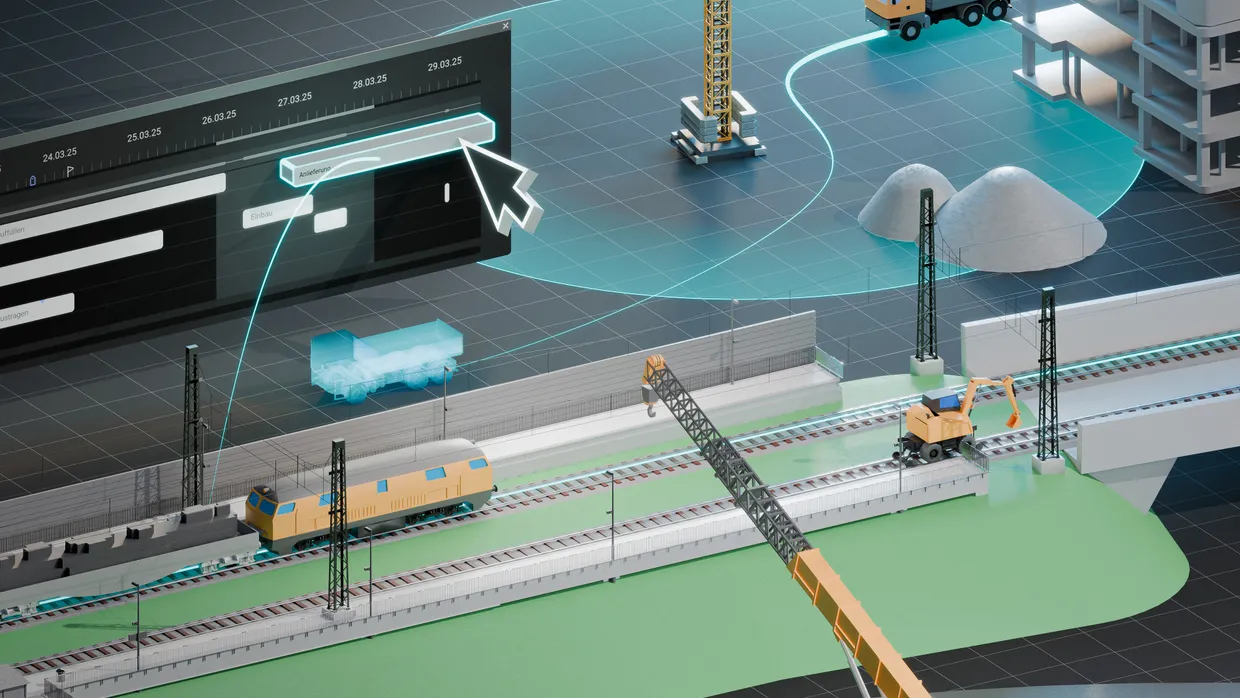
A construction process simulation reproduces the planned build digitally and calculates it through with real machine, logistics and time data. That makes it possible to check, long before construction starts, whether a schedule adds up, where bottlenecks arise and which variant is the safest. Mistakes then surface in the model rather than on site.
From a plan to a model that calculates
It begins with a digital replica of the site: the structure, its surroundings, the setup and logistics areas, the access routes. The hard numbers then go into that model. They include the output data of the machines deployed, the planned construction process and the constraints of the project, from the possession window through to the permissible axle load.
Once the model is populated, the construction process is calculated over time. Material and mass movements, transport routes and takt all follow from the data held in the model. Where activities block one another, where an area is too small or a takt too tightly set, the model shows it.
The last step is the most important one. The conflicts uncovered are assessed in engineering terms, variants are run and compared against one another, until a solution stands that holds up under pressure too.
What the project gains
The benefit rarely shows up as a single large figure. It sits in the many problems that never arise in the first place, and in the confidence with which a team goes into delivery:
- Spatial and temporal conflicts become visible early, not first on site
- Deliverability is demonstrated, even within tight possessions
- Logistics and transport concepts are validated before they are ordered
- Decisions rest on traceable figures rather than on rules of thumb
- Risks are assessed while they can still be cleared cheaply
Simulation moves the trial and error off the construction site and into the model, where mistakes cost nothing but compute time.
When the effort pays off
Not every project needs a simulation. Its greatest leverage comes where there is little room to maneuver: tight possessions on rail and road projects, dense site logistics, confined inner-city areas, and anywhere a single critical schedule chain carries the whole project.
Timing is decisive. The earlier the simulation enters the planning process, the more its results can still shift. During delivery it can still safeguard individual variants, but by then the big decisions are long since taken. For owners, planners and contractors that means it is most effective during design, long before the first machine arrives.
Frequently asked questions
What is meant by construction process simulation?
A construction process simulation is a dynamic digital replica of the planned build. Construction phases, machines, material and logistics flows are calculated over time and visualized using real output data, in order to test whether the plan can be delivered and to spot conflicts before construction starts.
What data does a construction process simulation need?
The basis is the structural drawings and the construction schedule. A BIM or surroundings model is helpful but not a must. Machine and logistics data are typically added, and further data speed the process up. The more data go into the model, the more valuable the insights the simulation can deliver.
When is a construction process simulation worthwhile?
Especially where possessions are tight, logistics dense, sites confined or schedule chains critical. The earlier it enters the planning process, the greater the leverage on certainty and cost.