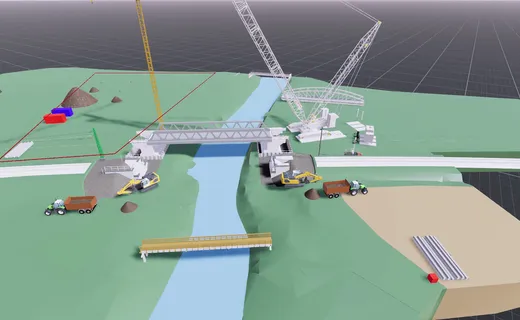
When every centimeter counts: site logistics validated by simulation

For the replacement of the Loeringhoff bridge, a steel structure weighing several hundred tonnes had to be transported to the river, turned and loaded in a very confined space. Process simulation showed before construction began that the planned construction process works — and where the highest precision would be required.
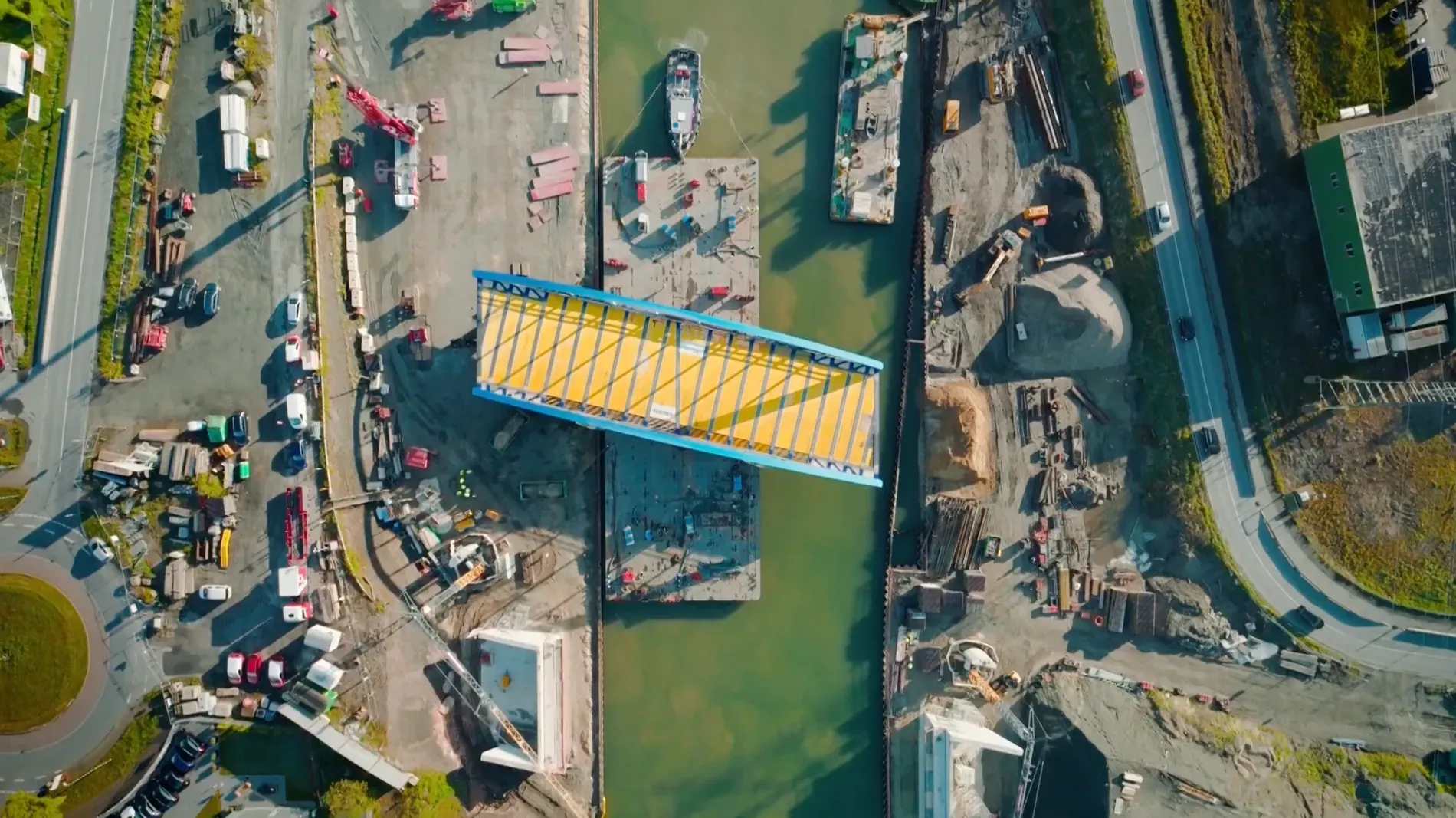
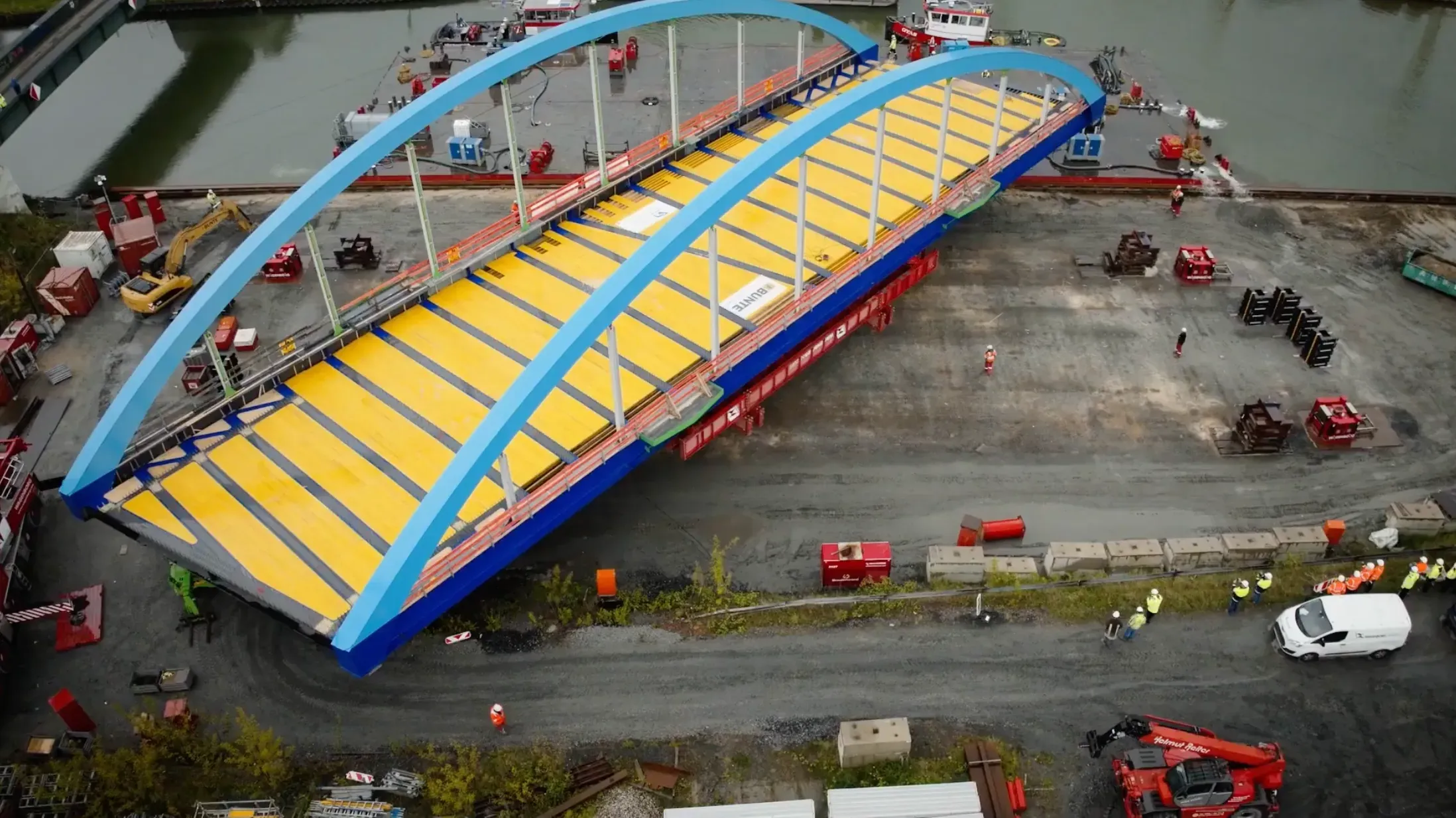 The pre-assembled steel bridge on heavy-load transporters — ready to be moved to the bank© 2025 Johann Bunte Bauunternehmung
Spatially, almost no mistake was permitted.
The pre-assembled steel bridge had to be moved from the assembly area down to the river. Between the assembly area, the embankment and the bank, however, there was only very limited room to maneuver.
- extremely narrow haul routes
- steep level differences down to the bank
- limited maneuvering space
- several crane and transport operations that had to mesh
- no scope for improvised corrections during the move
Even small planning errors would have delayed the entire sequence.
Drawings did show the geometry of the site, but they did not answer the decisive question: can the planned sequence actually be carried out with the real vehicle movements?
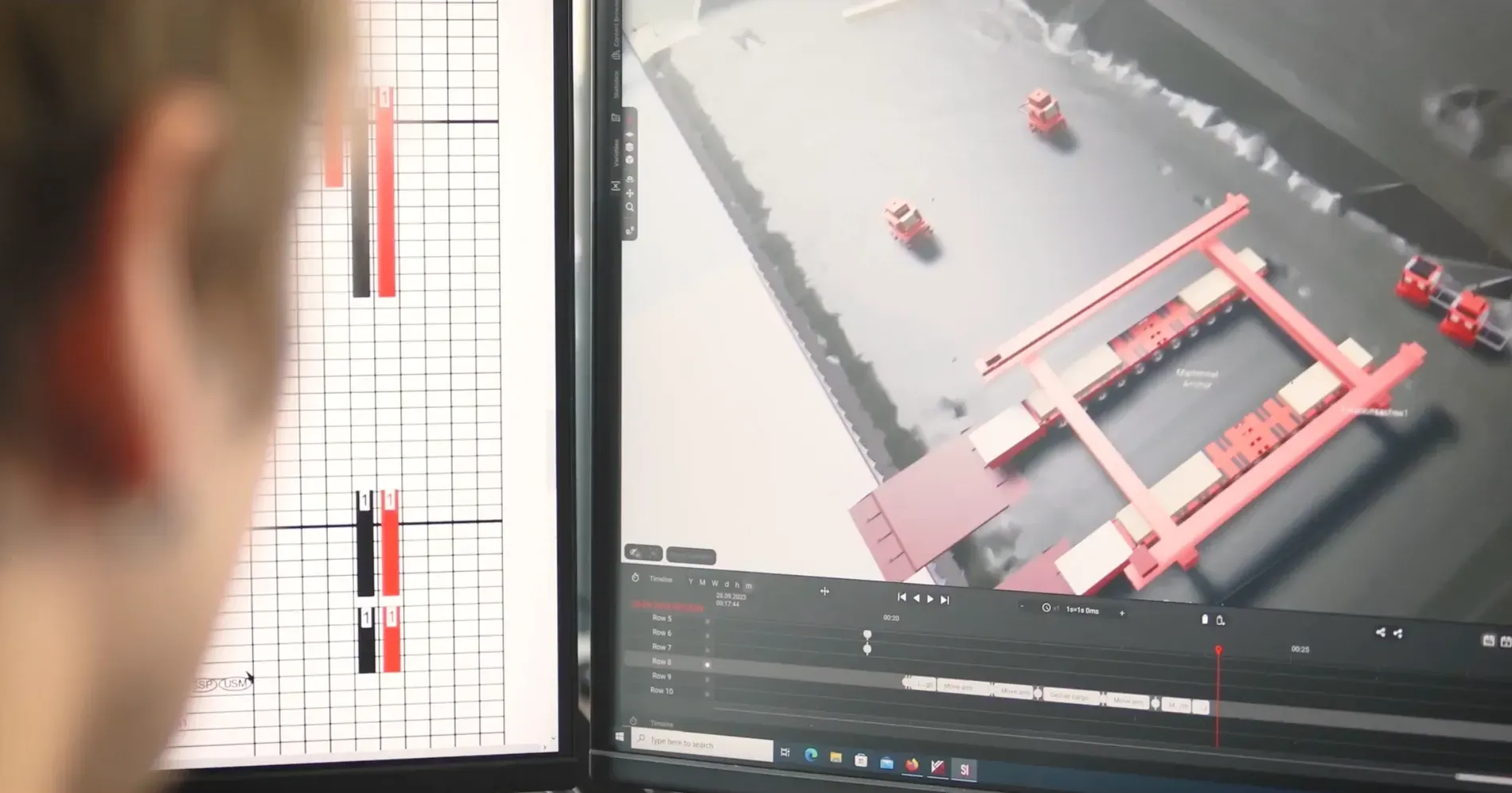
The entire site logistics were simulated in advance.
A true-to-life digital terrain model of the whole site.
Embankments, banks, ramps and assembly areas at the Dortmund–Ems Canal in Datteln were reproduced digitally exactly as they were on the ground — centimeter by centimeter. Only this 1:1 replica of reality made the simulation sound.
On that basis, every single step in moving the roughly 500-tonne steel bridge was run through not schematically but in the real terrain.
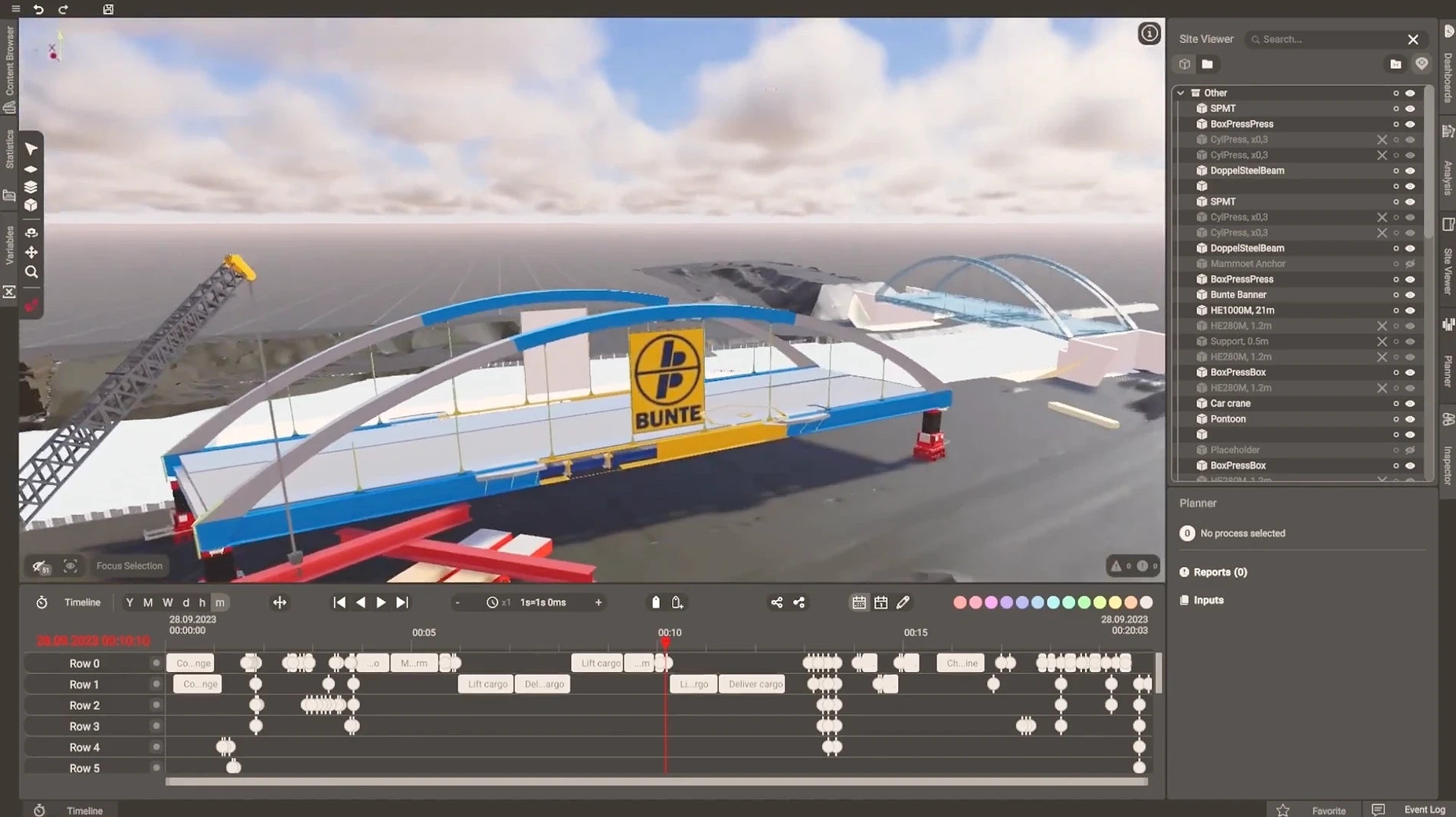
What was planned in the model ran on site exactly as intended.
 © 2025 Johann Bunte Bauunternehmung
The construction process was feasible — but only with maximum precision.
The simulation confirmed that the plan was deliverable in principle. At the same time it showed where the sequence reached its limits — and prepared the site crew for exactly that.
- which movements left virtually no clearance
- which maneuvers demanded the highest precision
- where particular attention would be needed
Where the simulation decisively changed the construction process
The access to the river was tighter than expected.
The running gear could not be moved to the bank as a complete unit. The simulation showed:
- the long SPMTs had to approach one at a time
- each transport unit had to be maneuvered separately
- the running gear could only be fully assembled at the riverbank
That safeguarded the actual assembly sequence at an early stage.
Three rotations instead of one.
After assembly the bridge stood at roughly 90° to its later direction of travel. The simulation showed that turning it directly was not possible. Instead the structure had to:
- be moved around a defined pivot point
- be turned in three separate rotation steps
- be repositioned several times to line up safely within the available area
What process simulation made possible
The complete construction process was checked realistically before anyone went on site.
Pinch points and critical movements became visible early.
Everyone involved could follow the sequence before the move took place.
Complex maneuvering and lifting operations were planned without surprises.
“The simulation proved in advance that the sequence works. It also showed where there would later have been virtually no clearance at all.”
Planning certainty is not created on paper.
On complex construction projects it is not only technical feasibility that decides the outcome, but whether the work can actually be delivered on site. True-to-life process simulation made it possible to validate the entire transport and assembly sequence of the Loeringhoff bridge before construction started — including every pinch point, maneuver and critical movement.
A similar challenge?
Tell us about your project — we will show you how transport, maneuvering and assembly can be safeguarded in advance.
More case studies